

Blogs
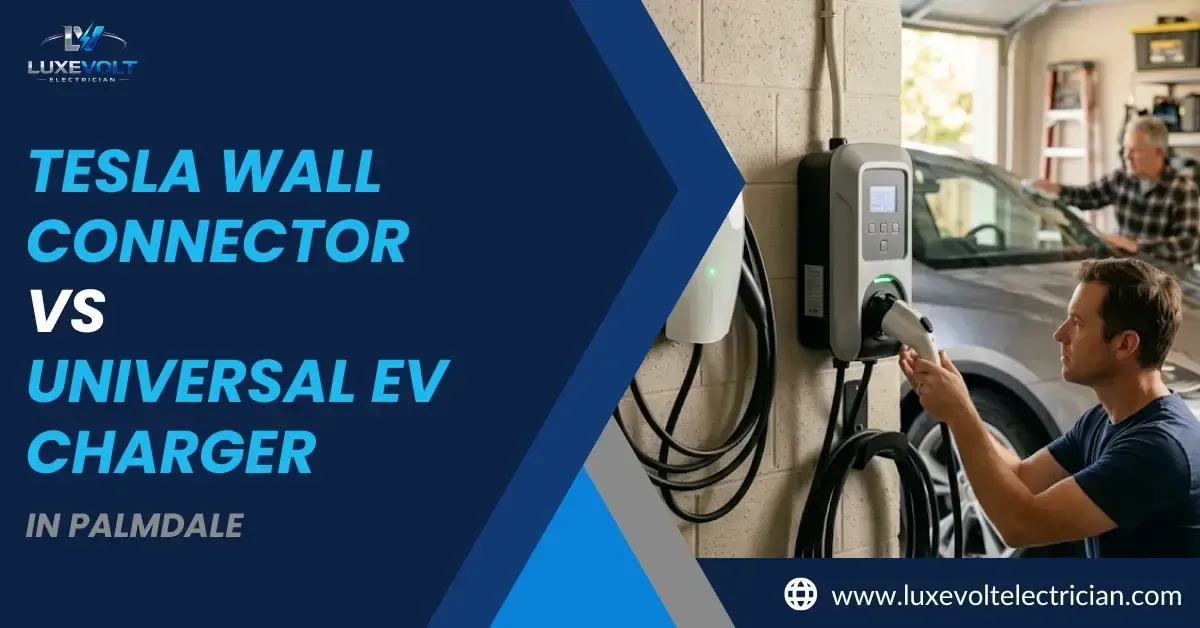
Tesla Wall Connector vs Universal EV Charger: What's Better?
The Tesla Wall Connector is better for Tesla-only homes, and the Universal EV charger is better for homes with a non-Tesla or a mix of brands.
Both push the same 11.5 kW and add up to 44 miles of range per hour. The right pick depends on which cars park in your garage and what you plan to drive next. We get this question almost every week from folks in Palmdale, Lancaster, and Quartz Hill who just picked up a new EV and want to charge at home.
Luxevolt Electrician will walk you through the full Tesla Wall Connector vs Universal EV charger picture in plain words, with real prices, real charging speed, and real install info from jobs we run across the Antelope Valley.
Key Takeaways
The Tesla Wall Connector ($475) works only with Tesla cars using a NACS plug, while the Universal EV charger ($500–$650) works with every EV brand thanks to a built-in J1772 plug.
Both chargers push the same 11.5 kW at 48 amps and add up to 44 miles of range per hour, so charging speed is a tie and depends on your car, not the charger.
The Tesla Universal Wall Connector is the best pick for homes with both a Tesla and a non-Tesla EV, since the J1772 plug clips right on the side with no loose adapter to lose.
A full Level 2 EV charger install in Palmdale and the Antelope Valley runs $1,200 to $2,200 with the charger included, plus $1,500–$3,500 if your panel needs a 200-amp upgrade.
LA County requires a permit for every Level 2 install, and Luxevolt Electrician pulls the permit, checks the panel free, and handles the full code-compliant install across Palmdale, Lancaster, and Quartz Hill.
What Is the Tesla Wall Connector?
The Tesla Wall Connector is Tesla's home Level 2 charger built for Tesla cars only, with a NACS plug and up to 48 amps of power.
Tesla sells it for about $475. It comes with a 24-foot cable, which reaches just about any car parked in a normal two-car garage. It has Wi-Fi, app control, and gets software updates over the air, same as your Tesla. If you own only a Tesla, this unit is clean, fast, and the cheaper way to go.
The catch is the plug. If a friend pulls up in a Ford F-150 Lightning, you can't plug it in without a J1772 adapter that runs $30 to $135. And that adapter has to live somewhere, so most people lose it.
What Is a Universal EV Charger?
A Universal EV charger is a Level 2 home charger that works with every EV brand sold in the U.S., not just Tesla.
Tesla makes one called the Tesla Universal Wall Connector. It runs about $595 to $620 and has both plug types built right in. The J1772 plug clips on the side of the unit. You just grab it, snap it on, and plug into your non-Tesla. Other good picks here are the ChargePoint Home Flex and the Wallbox Pulsar Plus, with prices from $500 to $700.
Tesla Wall Connector vs Universal EV Charger: Side-by-Side
Both chargers push the same 48 amps, but the plug type and price are not the same.
Here's the quick look:
Are They the Same Charging Speed?
Yes, both chargers put out the same 11.5 kW at 48 amps, so charging speed is a tie.
The speed you actually get at home depends more on your car than your charger. A Tesla Model 3 Long Range can pull the full 48 amps and charges at top speed on either unit. A Chevy Bolt only takes 32 amps, so it charges slower on both. That slow speed is the car's limit, not the charger.
Before you spend more on a faster unit, check your car's onboard charger rating first.
How Much Does Each One Cost Installed in Palmdale?
A full Level 2 EV charger install in Palmdale runs about $1,200 to $2,200 with the charger included.
Here's the real cost breakdown for the Antelope Valley:
Tesla Wall Connector unit: $475
Tesla Universal Wall Connector unit: $595 to $620
ChargePoint Home Flex (Universal): $500 to $600
Install labor in Palmdale: $500 to $1,500
Panel upgrade if needed: $1,500 to $3,500
LA County permit: $75 to $200
A lot of older Antelope Valley homes off Avenue R or near Sun Village still have 100-amp panels from the 80s and 90s. Those panels often need a bump up to 200 amps before a 48-amp charger can go in. Luxevolt Electrician checks your panel free, then gives you a flat price before any work starts.
Which One Should You Pick? Real Cases We See Every Week
The right pick depends on what's parked in your garage today and what you plan to drive in three to five years.
Here are the most common cases we see across Palmdale and Lancaster:
You Own Only a Tesla
Go with the regular Tesla Wall Connector. Save the $150. The plug fits your car, the Tesla app already controls it, and you don't need any adapter.
You Own a Non-Tesla EV
Pick a Universal EV charger with a J1772 plug. The ChargePoint Home Flex at around $550 is a solid choice. The Wallbox Pulsar Plus works just as well.
You Have a Tesla and a Non-Tesla at Home
Get the Tesla Universal Wall Connector. The built-in J1772 plug saves you from buying a loose adapter. One charger, two plug types, both cars ready in the morning.
You Plan to Switch EV Brands Soon
Buy Universal. Ford, GM, Rivian, and Hyundai are moving to the Tesla NACS plug, but most cars on the road today still use J1772. A universal unit covers both sides of that switch for the next few years.
You Rent or Plan to Sell Your Home Soon
Pick Universal. The next homeowner might drive any brand of EV. A Universal unit adds more value than a Tesla-only one when it's time to sell.
What About Just Buying a J1772 Adapter?
You can use a J1772 adapter to charge a non-Tesla on a Tesla Wall Connector, and it works fine at full 48 amps.
The Lectron adapter at $135 is the best one and handles full charging speed. Cheaper ones run $30 to $80 but feel flimsy. The problem with adapters is simple. They get lost. They can crack if you drop them on the garage floor. And every time a non-Tesla friend pulls up, you have to dig the adapter out and snap it on.
For most folks with two EVs, paying the extra $150 once for a Universal unit makes more sense than dealing with a loose adapter.
What Luxevolt Electrician Tells Every Customer Before They Buy
A few quick tips before you order any EV charger:
Check your panel size first. Homes built before 2000 often have 100-amp panels that need an upgrade for a 48-amp charger.
Pick a spot close to your panel. Long wire runs cost more in copper and labor.
Want to charge two cars at once? Tesla Power Share lets you link up to six Wall Connectors. ChargePoint Home Flex has the same feature.
Outdoor installs work fine in our dry desert weather, but mount under cover so the summer sun doesn't sit on the unit all day.
Luxevolt Electrician handles all of it. Free panel check, real permit, clean install, and a final inspection.
FAQs About Tesla Wall Connector vs Universal EV Charger
Can I charge a non-Tesla EV on a Tesla Wall Connector?
Yes, but only with a J1772 adapter. The Lectron adapter at $135 supports the full 48-amp charging speed.
Is the Tesla Universal Wall Connector worth the extra $150?
Yes, if you own a non-Tesla or a mix of EVs. The built-in J1772 plug saves you from buying a separate adapter.
Do both chargers work outside in Palmdale heat?
Yes. Both handle our summer heat fine outdoors. We still mount in shade so the unit stays cooler.
How long does the install take?
Most installs in the Antelope Valley take three to five hours. Panel upgrades add another half day.
Do I need a permit in Palmdale or Lancaster?
Yes. Every Level 2 EV charger install needs a permit in LA County. Luxevolt Electrician pulls it for you.
Can I install the EV charger myself?
We don't recommend it. California law needs a licensed electrician for the permit and final inspection on a 240-volt, 48-amp circuit.
Ready to Pick Your EV Charger? Call Luxevolt Electrician
If you only drive a Tesla, the regular Wall Connector saves you money. For mixed EV homes, the Universal Wall Connector is the better pick.
Luxevolt Electrician is your local Palmdale electrician for clean, code-passing EV charger installs across the Antelope Valley. Straight prices, real permits, and the job done right the first time. Free estimates any day of the week.


Precision Craftsmanship. Timeless Quality.
© 2026. All rights reserved.